

Propiedades del soporte temporal.
El soporte temporal adecuado a la práctica del Heliograbado manual debe reunir algunas condiciones que se enumeran a continuación:
- Siguiendo la tradición histórica, puede tratarse de un soporte de papel transpirable para facilitar su secado cuando se invierta sobre plexiglás o vidrio en la fase de sensibilización con el foto-iniciador. De hecho, el secado por inversión sobre plexiglás o vidrio, también llamado esmaltado o ferrotipado (ferrotyping), pretende eliminar de la capa de gelatina la textura propia de la fibra del papel de soporte. Dicha textura dificulta posteriormente la correcta adhesión a la superficie de cobre pulido.
- Alternativamente se pueden utilizar soportes sintéticos que al ser impermeables impiden que el secado se pueda realizar invirtiéndolo sobre vidrio o plexiglás, aunque secan perfectamente al aire y si su superficie es lo suficientemente lisa, no transfieren a la gelatina ninguna textura.
- El soporte temporal debe incorporar un grosor de gelatina suficiente para soportar el endurecimiento necesario de la misma en las altas luces como consecuencia de su exposición a la luz ultravioleta (UV). A título orientativo, el grosor de la capa de gelatina del Autotype G35 se anunciaba como de 45 µm ó 0,045 mm.
- Debe también incorporar un pigmento dispersado en la gelatina que controle el contraste y la difusión de la luz durante la exposición. Este pigmento facilita también el control de la fase de lavado de la gelatina no endurecida, la observación de la imagen cuando la reserva de gelatina está ya adherida a la plancha de cobre y el control visual de la progresión del grabado al ácido.
- De forma opcional, se pueden añadir algunos aditivos como:
- Una cierta cantidad de Azúcar que confiera elasticidad a la capa de gelatina seca y evite la formación de grietas durante las diversas manipulaciones en seco.
- Una cierta cantidad de Glicerina que asegure la absorción de vapor de agua del ambiente, lo que ayuda también a mantener una cierta flexibilidad en el soporte temporal.
- Productos que eviten la formación de burbujas en la papilla (también conocida por su denominación en inglés, glop), como el Alcohol Isopropílico.
- Preservativos que eviten el crecimiento prematuro de moho en la mezcla preparada, ya que la gelatina es un medio de cultivo excelente para multitud de microorganismos. El Timol es uno de los más utilizados.
Los materiales más habituales en la preparación de un soporte temporal para heliograbado son:
- Papel de acuarela satinado.
- Papel fotográfico sin sensibilizar.
- Papel fotográfico BN sin exponer, fijado y lavado.
- Película fotográfica o radiográfica fijada y lavada.
- Papel sintético de uso en Artes Gráficas y/o Diseño Gráfico.
- Acetato transparente.
Inconvenientes de los distintos soportes
A modo de inconveniente, cualquier soporte, sea de papel o sintético, puede contener productos que interaccionen de forma negativa con la gelatina y/o con el foto-iniciador empleado en su sensibilización. Estas interacciones y de forma general, pueden dividirse en tres grandes grupos:
- Interacción química.
- Generación de burbujas.
- Difusión y reflexión de luz en el interior de la capa de gelatina.
Las interacciones de índole química pueden producirse a causa del encolado de algunos papeles (internal sizing) y/o de los aditivos alcalinos que se añaden en algunos casos con fines de preservación (buffering). Resulta muy difícil pronosticar en que medida se producirán estas interacciones para el caso de un papel determinado. En el caso del papel tradicional, quizá el papel fotográfico fijado y lavado o el suministrado por ADOX sin sensibilizar serían las opciones más neutras disponibles puesto que ya en su caso se han tomado precauciones para que el soporte no tenga interacción química con el fin al cual están destinados estos papeles. Sin embargo, ello comporta un coste económico superior al del papel tradicional y la dependencia de la permanencia en el mercado de este tipo de materiales, cuyo uso futuro es incierto.
En el caso de los papeles sintéticos y acetatos adecuados para fotocopiadoras o impresión láser, los recubrimientos que incorporan para retener el tóner o la tinta en su superficie pueden también pueden interaccionar de forma negativa tanto con la papilla de gelatina como con el foto-iniciador en la fase de sensibilización. Al igual que en el caso de los papeles tradicionales, no suele estar disponible una información clara sobre la composición de dichos recubrimientos, por lo que sólo la experimentación dará pistas sobre su grado de idoneidad en cada caso. Ante la duda, un lavado previo con detergente y esponja, aclarado y secado adecuados, eliminará a buen seguro estos recubrimientos. Los soportes mencionados, después de lavados, tienen como contrapartida que la capa de gelatina seca tiende a despegarse de los bordes con humedades relativas bajas (RH<50%).
Interacciones químicas. Aunque casi todos los soporte mencionados contienen sustancias que pueden interaccionar con la gelatina, con el foto-iniciador empleado o con ambos a la vez, alterando sus propiedades, hasta la escritura de este texto se han probado el papel Arches Aquarelle 185 g/m2, el papel sintético Yupo de 200 g/m2, el papel sintético Synaps de 200 g/m2, acetato transparente Canson C50 de 100 µm y acetato Q-CONNECT KF26066 de 100 µm. Con todos ellos, utilizando Dicromato de Potasio como foto-iniciador y alguna precaución que se detalla más adelante, se han obtenido resultados satisfactorios sin ningún tipo de lavado previo.
Formación de burbujas. Con todos los soportes mencionados, la formación de micro-burbujas en el interior de la capa de gelatina seca se ha podido controlar por dos vías simultáneas. En primer lugar hay que prestar atención a la prepración de la papilla de gelatina. Agitar en agitador-calefactor magnético a velocidad moderada es de gran ayuda para evitar la formación excesiva de burbujas, así como esperar al menos 1 h antes de utilizar la papilla ya preparada y filtrada. Otro factor importante es filtrar la papilla a través de un tejido de algodón o sintético y añadir posteriormente un 3% (volumen/volumen) de alcohol isopropílico. Por último y ya en la fase de extensión de la papilla sobre el soporte de papel tradicional o sintético, tratar de igualar las respectivas temperaturas. La temperatura de la papilla puede bajarse hasta los 37-38ºC sin que pierda fluidez. La plancha metálica nivelada (ver instrucciones de extensión) puede atemperarse previamente con un secador de aire caliente para igualar su temperatura con la de la papilla. La mayoría de las reacciones entre la papilla y los recubrimientos de los soportes parecen tener lugar cuando las respectivas temperaturas son más diferentes.
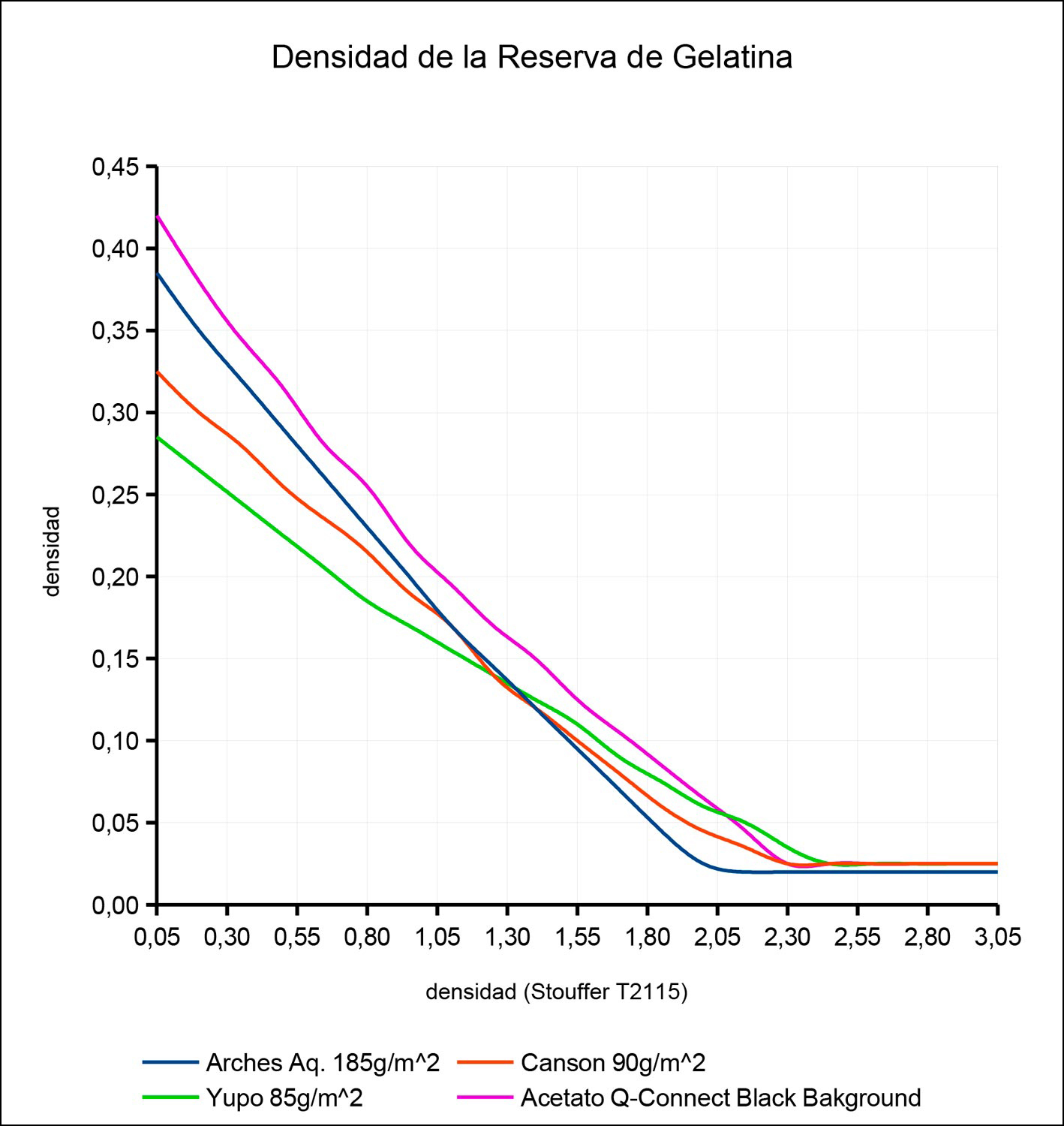
Difusión y reflexión de luz en el interior de la capa de gelatina. Según las propiedades del soporte utilizado en cada caso, se va a producir una mayor o menor difussion y reflexión de luz en el interior de la capa de gelatina durante la exposición. Si el material en cuestión contiene blanqueadores ópticos, éstos suelen emitir fluorescencia al absorber luz UV. Esta fluorescencia es generalmente de longitud de onda mayor que la de la luz UV que reciben y pertenece al espectro de la luz visible (VIS). Ello provoca que según el soporte utilizado, una misma composición de foto-iniciador y gelatina produzcan contrastes distintos. El inconveniente no es grave y de fácil solución mediante el control adecuado del contraste de la transparencia positiva. Mediante el revelado si se trata de transparencia sobre película fotográfica o mediante procesado de imagen si se trabaja con transparencias preparadas en impresoras de chorro de tinta. En la Fig., 1 se muestran las variaciones de sensibilidad y contraste que se observan al utilizar una misma papilla sobre diferentes soportes. El foto-iniciador y la exposición es la misma para todos ellos.
Carbon-tissue properties. The carbon-tissue intended for the practise of hand made Heliogravure should accomplish with some properties as follows:
- Following with the tradition, the carbon-tissue could be prepared on a traditional breathable paper that facilitates the drying on glass or plexiglass during the sensitization with a photo-initiator. The drying inverting the sensitized carbon-tissue onto a glass or plexiglass, also called ferrotyping, aims to eliminate the fiber paper texture present on the gelatin surface. If this texture remains on the gelatin surface, it difficult the later laydown on the copperplate surface.
- Synthetic supports can be also used. Those materials, being impermeables, cannot by dried by ferrotyping, but simply hanging under dust-free air fow. If the support material surface is smooth enough, it do not tranfers any texture to the gelatin surface.
- The carbon-tissue must incorporate a thickness of gelatin capable to include the hardening generated by a suited exposure in the image highlights. As a general guidance, the gelatin thickness in the former Autotype G35 was announced as 45 µm or 0,045 mm.
- The carbon-tissue must also incorporate a pigment into the gelatin in order to control both the contrast and the light diffusion during the exposure time. This pigment facilitates also the control of the non-hardened gelatin final wash, the image observation as a resist on the copperplate and the visual progression of the etching process.
- Optionally, several additives can be used in the gelatin glop:
- Some quantity of Sugar in order to plasticize the gelatin layer and avoid the unwanted cracks during its manipulation.
- Some amount of Glycerol ensuring the absorption of humidity from the ambience, helping also to maintaining a certain flexibility of the carbon-tissue.
- Some drops of Isopropyl Alcohol avoiding an excess of bubbles and micro-bubbles.
- Some preservative preventing the growing of mould, because gelatin is an excellent culture media for numerous micro-organisms. Tymol is one of most used.
The most commonly used materials in preparing a carbon-tissue for heliogravure are:
- Satin watercolour paper.
- Non sensitized photographic paper.
- BW photographic paper unexposed, fixed and washed.
- Non exposed photographic or radiographic film, fixed and washed.
- Synthetic paper used in Graphic Arts or Graphic Design.
- Transparent acetate.
Drawbacks of the support
As a drawback, any support, both of traditional or synthetic paper, can incorporate products negatively interacting with the gelatin and/or the photo-initiator employed. As a general rule, those interactions can be classified in three main groups:
- Chemical interaction.
- Generating bubbles.
- Diffusion and reflection of light into the gelatin layer.
The chemical interactions can be caused by the internal sizing of some traditional papers and/or by the buffering solutions added as a preservation agents. It is really difficult to foresee which is the actual risk with a given paper. Among traditional paper, perhaps the non exposed, fixed and washed photographic paper and the non sensitized provided by ADOX are the more neutral options in the market, because in their manufacturing there have been taken precautions in order to avoid this problem. Nevertheless, this adds a higher economic cost and the uncertainty about its permanence in the market for the mid term.
For the group of synthetic papers or transparent acetates, the usual coating intended to well absorb the toner or ink in its surface, can cause also a negative interaction with the gelatin glop or the photo-initiator during the sensitizing step. In the same way as for the traditional papers, there is not common a precise information about the compounds used for this purpose. Then, only the experimentation could provide knowledge about its suitability. If in doubt, a previous washing with detergent and sponge, followed by a deep rinsing, will eliminates those coatings. As a drawback, this previous washing provokes sometimes a lack in adherence of the dried gelatin layer in the sheet borders, specially with low humidity (RH<50%).
Chemical interactions. In spite that almost all mentioned supports contain some substances that could interact with the gelatin, the photo-initiator or with both, until the moment to write this text the following supports have been experimented: Arches Aquarelle 185 g/m2, synthetic paper Yupo of 200 g/m2, synthetic paper Synaps of 200 g/m2, transparent acetate Canson C50 of 100 µm and transparent acetate Q-CONNECT KF26066 of 100 µm. Taking some preventions that will be detailed fordward, all of them have proven satisfactory with Potassium Dichromate as photo-initiator and without any previous washing.
Bubbles formation. With all above mentioned supports, the formation of micro-bubbles into the gelatin layer has been controlled by two main ways. It is very important to be cautious during the glop preparation. Stir the glop in a magnetic stirrer at moderate speed is of paramount help to avoid an excessive presence of bubbles. Wait 1 h at least before the use of the glop once it is already prepared and filtered. Another important fact is to filter the glop through a cotton rag or synthetic fabric and finally add a 3% (volume/volume) of Isopropyl Alcohol to the filtered glop. Finally, when extending the glop onto the traditional or synthetic paper, try to equal the respective temperatures. The glop temperature can go down to 37-38ºC without a notable loss in fluidity. The metal surface supporting the paper could be previously heated with a hair drier in order to rise the temperature close to that of the glop. Most reactions between the glop and the support coating seems to occur when the respective temperatures are quite different.
Light diffusion and reflection into the gelatin layer. Depending on the carbon-tissue support material, it will occur an internal diffusion and/or reflection of light into the gelatin layer. Those papers containing optical brighteners tend to emit fluorescence as a response to the UV light absorption. This fluorescence is usually of a longer wavelength belonging to the visible (VIS) spectrum. Depending on the support, changes in contrast and sensitivity can be observed for a given glop. This is not so serious and it can be fixed with a suitable control of the positive transparency contrast. By the development with photographic film or by digital image processing with transparencies obtained on inkjet printers. The Fig., 1 (bottom) shows the sensitivity and contrast variations obtained extending the same glop on different supports. Photo-initiator and exposure are the same for all of them.
 Carles Mitjà - ASIS/FRPS
What an extraordinarily valuable resource this is, Carles ! From a great deal of highly focused research and analysis, your conclusion about using synthetic materials for supports makes eminent common-sense. This is something I have wondered about ever since the crisis many years ago of Autotype ending its 125-year-long production. You have also unveiled many creative possibilities with variations in proportions of gelatin, pigment, and sugar.
LikeLiked by 1 person
Thank you Peter. Now we, european citizens, still have to find an equivalent substitute for the Potassium Dichromate. Step by step.
LikeLike