

Composición de la papilla de gelatina. Como ya se comentó, los tres elementos esenciales de la papilla para el soporte temporal de Heliograbado son la gelatina, el azúcar y el pigmento. De éstos, los que en realidad influyen en la exposición, el contraste y la gama tonal son la gelatina y el pigmento.
La Gelatina. La gelatina se puede adquirir de muchos tipos diferentes según su procedencia. Bovina, porcina, de piel, de huesos, de cartílagos o mezclas diversas de todos estos tipos. En realidad y salvo alguna excepción, la mayoría de gelatinas disponibles en el mercado no especifican de qué están compuestas.
Otra propiedad de las gelatinas es su grado Bloom, grado que sí suele especificarse en gelatinas de cierta calidad. El grado Bloom determina la resistencia mecánica de la gelatina en estado gelificado. De dicha resistencia se deriva también la facilidad con que un líquido puede penetrar en la gelatina gelificada. Como puede suponerse, ésto tiene importancia durante la fase de grabado al ácido, en la que el Cloruro de Hierro (III) debe hinchar y penetrar la reserva de gelatina que recubre la plancha de cobre.
A partir de los ensayos realizados, se puede afirmar que muchas gelatinas, en el rango entre grado Bloom 200 y Bloom 290, pueden funcionar de forma adecuada para Heliograbado. Según su composición, a menudo desconocida, y su grado Bloom, el grabado al ácido necesitará diluciones de Cloruro de Hierro (III) distintas para conseguir un resultado correcto para una misma gama tonal.
El tipo de gelatina que se utilice y las propiedades que ésta aporte al soporte temporal quedarán pues incorporados al calibrado del sistema que cada practicante debe realizar. Por ello, es conveniente decidirse por una gelatina en particular y asegurarse de que no habrá interrupciones de suministro a corto plazo o proveerse de una cantidad que permita afrontar el calibrado y la práctica a medio y largo plazo. Hasta el momento de escribir este texto, se han probado las siguientes tres gelatinas:
- ADOX Colloida P, Bloom 289.
- GMW, Bloom 250.
- Inka Foods 1005 Bovine, Bloom 200.
Con todas ellas se han conseguido resultados satisfactorios atendiendo de forma correspondiente a los cambios de comportamiento en el grabado al ácido aportados por cada una.
El Pigmento. El pigmento que se ha incorporado tradicionalmente al soporte temporal para Heliograbado tiene diversas funciones en las diferentes etapas del proceso. A modo de resumen y según la experiencia del autor, se pueden nombrar las siguientes:
- Limitar la penetración de la luz UV durante la exposición, tanto de la trama como de la transparencia positiva.
- Facilitar el control visual del lavado de la reserva adherida a la plancha de cobre.
- Proporcionar una imagen visible (negativa) en la reserva adherida a la plancha de cobre.
- Seguir visualmente la consecución del grabado al ácido. Permite controlar el inicio, su progresión y detenerlo en el momento oportuno para evitar un grabado excesivo de las altas luces.
La primera de esas funciones implica que tanto el tipo de pigmento como su concentración en la papilla hay que mantenerlos constantes para que permitan el calibrado del sistema. Al igual que con las gelatinas, los pigmentos se pueden encontrar de diversos tipos y formas. En polvo, en suspensión líquida y en pasta. Es fundamental que se asegure que no incorporan grumos y/o partículas sólidas. Algunos practicantes recomiendan el filtrado previo para evitar los grumos y partículas presentes en pigmentos líquidos de precio económico. Hay que precisar que aunque el filtrado puede eliminar dichos grumos, la concentración real de pigmento después del filtrado será variable, pues la cantidad de grumos y/o partículas por unidad de volumen será diferente de unas veces a otras. En cuanto al color, la tradición es utilizar un Rojo Óxido, aunque otros colores podrían ser también útiles. Nótese que, para un mismo pigmento y concentración, la influencia del color en el resultado de la exposición a la luz UV, es función del espectro emitido por la fuente de luz UV que se emplee. En los ensayos que concluyen en este texto se ha utilizado siempre el Rojo Venecia 349 perteneciente a la serie Rembrant de pasta de acuarela de la marca Royal Talens. En el tubo se indica que el pigmento empleado es el PR101 u Óxido de Hierro (III).
Proporciones de gelatina y pigmento. Si se acude a la información disponible en foros y grupos de trabajo, se pueden encontrar proporciones de gelatina y/o pigmento diversas. Para determinar las que pueden ser más adecuadas, deben precisarse dos cuestiones:
- Lo que realmente importa es el espesor de gelatina seca que haya finalmente en la superficie del soporte temporal. Este espesor debe ser el suficiente para que pueda alojar la gelatina endurecida por la exposición de las altas luces.
- Para un pigmento dado, lo que acabará por influenciar la exposición y el contraste es la concentración de pigmento en relación a la cantidad final de gelatina seca.
De la primera cuestión se deriva que para un volumen fijo de papilla por unidad de superficie que se deposite sobre el soporte, el grosor de gelatina seca dependerá de la concentración de gelatina en la papilla. Del mismo modo, se comprende que diversas concentraciones de gelatina en la papilla pueden acabar generando el mismo grosor de gelatina seca si se modula de forma correspondiente el volumen de papilla por unidad de superficie que se deposite sobre el soporte.
Así pues, la cuestión que queda por definir es el espesor de gelatina seca más adecuado. El Autotype G35, uno de los soportes temporales para Heliograbado más utilizado de todos los tiempos, especificaba un espesor de 45 µm o 0,045 mm. Teniendo en cuenta que un proceso industrial con trenes de laminado con condiciones de temperatura, humedad y secado bien controlados permite un grado de precisión muy elevado, en la práctica manual es prudente permitirse un espesor algo mayor. A modo de ejemplo, con gelatina Colloida P de ADOX al 6% en agua y depositando 0,1 ml / cm2 de papilla sobre el soporte, se obtiene un espesor de gelatina seca de 50-60 µm, más que suficiente para Heliograbado.
Para poder precisar un volumen concreto de papilla por unidad de superficie, se recomienda utilizar el método de extensión mediante limitaciones laterales en el soporte, que permitan repartir el volumen en una superficie concreta (Fig., 1).
Con el pigmento mencionado anteriormente, la proporción adecuada para tener una exposición parecida a la del Dragon Gravure, suministrado por Cape Fear Press hasta julio de 2022, es un 2%. Por último, la cantidad de azúcar para conferir plasticidad al soporte temporal debería ser la mínima necesaria. Con soportes de papel tradicional, la aparición de grietas en la gelatina seca es más frecuente que en los soportes sintéticos. Con las proporciones mencionadas y azúcar de mesa blanco, un 50% respecto de la concentración de gelatina en la papilla, parece ser suficiente. Así pues y con los ejemplos mencionados, una composición de papilla que sirva de punto de partida, podría ser la siguiente:
- Gelatina ADOX Colloida P 289 Bloom (6%).
- Azúcar blanco (3%).
- Pasta de pigmento Rojo Venecia 349 de Royal Talens (2%).
- Volumen de papilla por unidad de superficie: 0,1 ml / cm2.
Obviamente, estas proporciones son sólo válidas para un rango de densidad de la transparencia positiva y una exposición y fuente de luz UV determinadas. En este caso, las que utiliza el autor. En cada caso deberá comprobarse, sobre todo en relación a la concentración de pigmento, si la proporción del ejemplo debe modificarse de acuerdo con los resultados obtenidos en las primeras pruebas de calibrado. Siguiendo con el ejemplo, si se quiera aumentar la sensibilidad del soporte temporal, se puede cambiar la proporción gelatina-pigmento de 6 : 2 a 6 : 1,5 ó 6 : 1. En ambos casos, la visibilidad de la imagen en la reserva será algo menor, sobre todo en la zona de las sombras donde la capa de gelatina es más delgada. Ello puede dificultar la visibilidad de la diferencia entre los parches del 100% y el 90% en la escala de grises.
Glop composition. As have been already said, three are the essential elements of the the carbon-tissue glop for Heliogravure: Gelatin, sugar and pigment. Among those, gelatin and pigment are the really intervening in the exposure, the contrast and the tonal range.
The Gelatin. The gelatin can be acquired of many different types depending on its origin. Cow, pig, skin, bones, cartilage or diverse combinations of those types. In fact and beyond some exceptions, the majority of gelatins available in the market do not specify from what are composed.
Another property of the gelatin is its Bloom grade, which is specified in some quality gelatins. The Bloom grade determines the mechanical strength of the gelled gelatin. From this strength is also derived the easiness for liquids penetration in the gelled gelatin. As you might guess, this is of paramount importance at the etching step, where the Ferric Chloride must penetrate the gelatin resist extended on top of the copperplate.
From the performed assays, it can be affirmed that several gelatins, in the range between Bloom 200 and Bloom 290, can be useful for Heliogravure. Depending on its composition, often unknown, and its Bloom grade, the etching will need different Ferric Chloride concentrations in order to achieve a correct result from a given tonal range.
The gelatin type chosen and the properties it contribute to the carbon-tissue, will then be incorporated to the system calibration each practiser must perform. It is therefore advisable to decide on a certain gelatin and make sure to avoid short-term supply problems or provide a sufficient quantity to allow calibration and practice in the medium and long term. As of this writing, three gelatins have been tested:
- ADOX Colloida P, Bloom 289.
- GMW, Bloom 250.
- Inka Foods 1005 Bovine, Bloom 200.
Satisfactory results have been achieved with all of them, paying attention at the necessary changes in the etching caused by the different properties.
The Pigment. The pigment traditionally used in carbon-tissue for Heliogravure has several functions on the different stages of the process. As a summary and from the author experience, we can list:
- To limit the UV light penetration during the exposure, both for the screen or the positive transparency.
- To help in the visual control of the gelatin resist washing.
- To provide a visible image (negative) in the gelatin resist adhered onto the copperplate.
- To follow visually the etching process. To be conscious of the beginning, its progression and to stop it at the intended time avoiding an excessive highlights etching.
The first one of those function implies that both the type of pigment as its concentration in the glop must be maintained stable allowing for the calibration of the process. In the same way as with gelatin, the pigments can be found in several types and forms, As powder, in liquid suspension and as a paste. It is very important to be sure the pigment does not have lumps and/or solid particles. Some practitioners recommend a previous filtering to avoid those lumps or particles for cheap liquid pigments. It is necessary to keep in mind that even the filtering will eliminate those problems, the actual pigment concentration will be variable after filtering, because the amount of lumps or particles will be different from time to time. As for the color pigment, the tradition is to use an Oxide Red, although other colours could be also useful. Note that for a given pigment and concentration, the influence on the exposure to the UV light is a function of emission spectrum of the UV light source used. In the author trials Venetian Red 349 of the watercolour Rembrant series from Royal Talens has been used. The tube indicates that the pigment is the PR101 or Ferric Oxide.
Gelatin and pigment proportions. Consulting the available information in groups or forums, diverse gelatin and/or pigment proportions can be found. In order to determine which can be more suited, a couple of things mas be stated:
- What is really important is the thickness of dry gelatin finally adhered on top of the carbon-tissue support. This thickness must be enough to receive the hardening of the high lights.
- For a given pigment, what will influence the exposure and the contrast is the proportion of pigment on the final amount of dry gelatin.
From the first statement it can be derived that for a given volume of glop for surface unit over the support, the thickness of the dry gelatin will be a function of the gelatin concentration in the glop. In the same way, it is easy to understand that different gelatin concentrations in the glop could ultimately provide the same thickness in the dried gelatin layer if the amount of glop per unit area is accordingly modified.
Threfore, the only fact that remains to decide is the more suited dry gelatin thickness. The Autotype G35 carbon-tissue, probably the most used carbon-tissue of all times, was specified as 45 µm in thickness, or 0,045 mm. Taking into account that an industrial process, with rolling mill where temperature, humidity and drying are well controlled, allows for a high degree of precision, in the hand made practice it is advisable to allow a slightly greater thickness. As an example, with Colloida P gelatin from ADOX at a concentration of 6% in water and with a ratio of 0,1 ml/cm2 of glop on the support, a dry thickness of 50-60 µm is obtained, thick enough to Heliogravure.
In order to precise a given volumen per unit area, it is recommended to use the method of glop extension with magnetic lateral limits over the support, allowing to extend the volume onto a given area (Fig., 1).
With the aforementioned pigment , the appropriate proportion to achieve an exposure similar to that employed with the old Dragon Gravure from Cape Fear Press, is 2%. Finally, the amount of sugar to plasticize the carbon-tissue must be the minimum necessary. With traditional papers as a carbon-tissue support, the appearance of cracks in the dried gelatin is more frequent than with synthetic supports. With proportions described above and white table sugar, an amount of 50% with respect the gelatin concentration seems to be sufficient. So that and with mentioned examples, an starting point for the glop composition would be as follows:
- ADOX Colloida P gelatin, 289 Bloom (6%).
- White sugar (3%).
- Venetian Red 349 pigment paste from Royal Talens (2%).
- Glop volume per unit area: 0,1 ml / cm2.
Obviously, these proportions are only valid for a given density range in the positive transparency and the UV light source used. In this case, those used by the author. Each one must check, specially in relation to the pigment concentration, whether these proportions of the example would change according to the results of the first calibration tests. Following with the example, if it is want to rise the carbon-tissue sensitivity, the relationship between the gelatin and the pigment could be changed from 6 : 2 to 6 : 1.5 or 6 : 1. In both cases, the image in the resist will be less visible, specially in the shadows area where the gelatin resist is very thin. This can make it difficult to see the difference between the 100% and 90% patches in the resist gray scale.
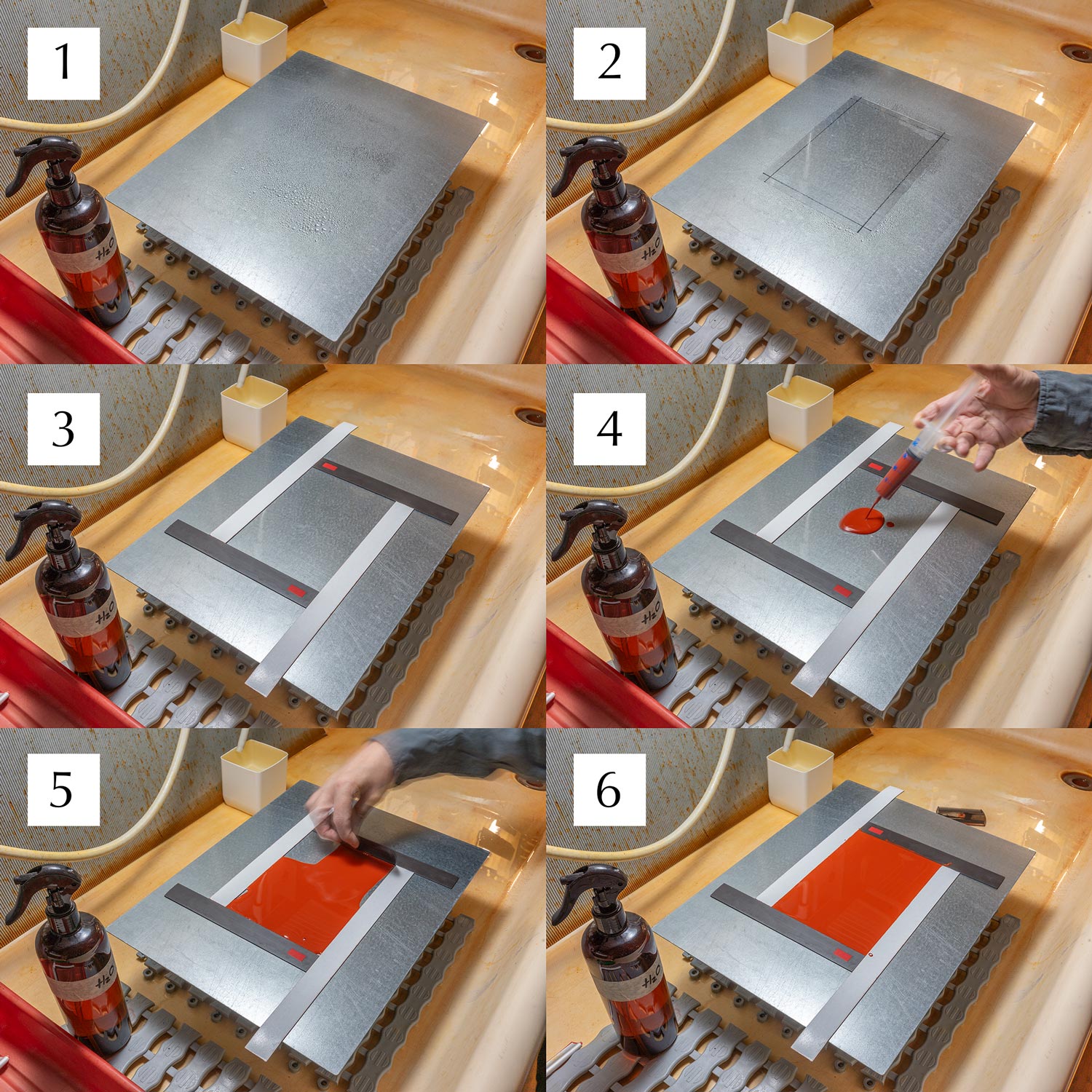
En la Fig., 1 se muestra, siguiendo la numeración:
- Superficie metálica nivelada con una cierta cantidad de agua destilada para adherir el material del soporte temporal.
- Soporte temporal de acetato transparente con marcas para la colocación de las bandas magnéticas de limitación del área a cubrir con gelatina.
- Bandas magnéticas en su posición.
- Deposición del volumen de papilla previsto.
- Extensión de la papilla hasta los borde con ayuda de una peine.
- Papilla en reposo a la espera de la gelificación.
Following the numbers, the Fig., 1 shows:
- Levelled metallic surface with some amount of distilled water in order to adhere te material of the carbon-tissue.
- Material support of transparent acetate with registration marks to place the magnetic tape limiting the area to be coated with gelatin.
- Magnetic tapes in position.
- Pouring the planned volume of glop.
- Extending the glop to the borders with the aid of a comb.
- The glop resting until the gelatin gells.
 Carles Mitjà - ASIS/FRPS