
Este post trata sobre la sensibilidad y el ritmo de crecimiento del grosor mostrado por las reservas de gelatina endurecida generadas a partir del uso de citrato férrico amónico (FAC) como substituto del dicromato de potasio como sensibilizante para Heliograbado.
En primer lugar, cabe mencionar que el uso de sales férricas comporta un cambio de procedimiento derivado de la forma diferente por la que se llega al endurecimiento diferencial de la reserva de gelatina que protegerá al cobre de la corrosión del mordiente. Cuando el sensibilizante empleado es el dicromato de potasio o el dicromato de amonio, la exposición a la luz ultravioleta (UV) genera un grosor de endurecimiento de la gelatina pigmentada en relación a la cantidad de luz recibida por el soporte temporal. Es decir, al tono de la imagen en la transparencia positiva. Así, los tonos claros generan un mayor espesor de gelatina endurecida que los tonos oscuros.
En el caso de las sales férricas (FAC o FAO), la luz UV sólo transforma el catión férrico (Fe+3) en ferroso (Fe+2). Es decir, las zonas que reciben mayor exposición, las más claras en la transparencia positiva, reciben más luz UV y en consecuencia, transforman una mayor cantidad de cationes férricos en ferrosos, pero el estado inicial de la gelatina no cambia. Posteriormente, los cationes ferrosos, mezclados con peróxido de hidrógeno (H2O2 o agua oxigenada), descomponen el peróxido generando la formación de radicales libres hidroxilo (HO·) que a su vez son capaces de iniciar el proceso de polimerización de la gelatina y su endurecimiento, lo que conlleva un aumento del punto de fusión. Por lo tanto, la exposición previa a la luz UV i la subsecuente mezcla con agua oxigenada conducen a un resultado similar al obtenido por exposición a la luz UV en presencia de dicromato de potasio o de amonio. En resumen, el proceso con el FAC es el siguiente:
- Soporte temporal de papel sintético con una capa de gelatina, plastificante y pigmento.
- Sensibilizar por inmersión en un baño de FAC o mediante aplicación con pincel.
- Secar en la oscuridad bajo corriente de aire libre de polvo.
- Exponer a la luz UV a través de la transparencia positiva o de la trama más la transparencia.
- Sumergir en un baño de agua oxigenada para proceder a la polimerización de la gelatina.
- Adherir a la plancha de cobre.
- Lavar con agua a 45ºC – 50ºC la gelatina no endurecida.
- Proceder al grabado al ácido de la forma habitual.
El uso de dichas sales férricas permite dos formas de sensibilización. La primera, del mismo modo que se procede con el dicromato de potasio, mediante inmersión en un baño de FAC o también aplicando el sensibilizante con pincel. Las pruebas empíricas muestran que para obtener resultados consistentes, la solución de FAC debe estar alrededor del 20%. Por debajo del 15% pueden experimentarse fallos de consistencia en la sensibilidad. Una segunda forma de sensibilización es añadir directamente el FAC a la papilla de gelatina pigmentada. Un 3% de la sal en polvo muestra resultados consistentes después de dos meses que el soporte temporal se ha mantenido en la oscuridad y en el refrigerador. En este caso, el procedimiento sería como sigue:
- Soporte temporal de papel sintético con una capa de gelatina, plastificante, pigmento y un 3% de FAC.
- Sacar del refrigerador y dejar que se equilibre con la temperatura ambiente. Para evitar la condensación de vapor de agua en la superficie de la gelatina, no extraer de la bolsa hermética en la que se guarda en el refrigerador hasta que el equilibrio de temperatura se haya producido.
- Exponer a la luz UV (primero a través de la trama si se practica la doble exposición) o directamente a través de la transparencia positiva en caso de usar aguatinta de polvo de resina o asfalto.
- Sumergir en un baño de agua oxigenada para proceder a la polimerización.
- Adherir a la plancha de cobre.
- Lavar con agua a 45ºC – 50ºC.
- Proceder al grabado al ácido de la forma habitual.
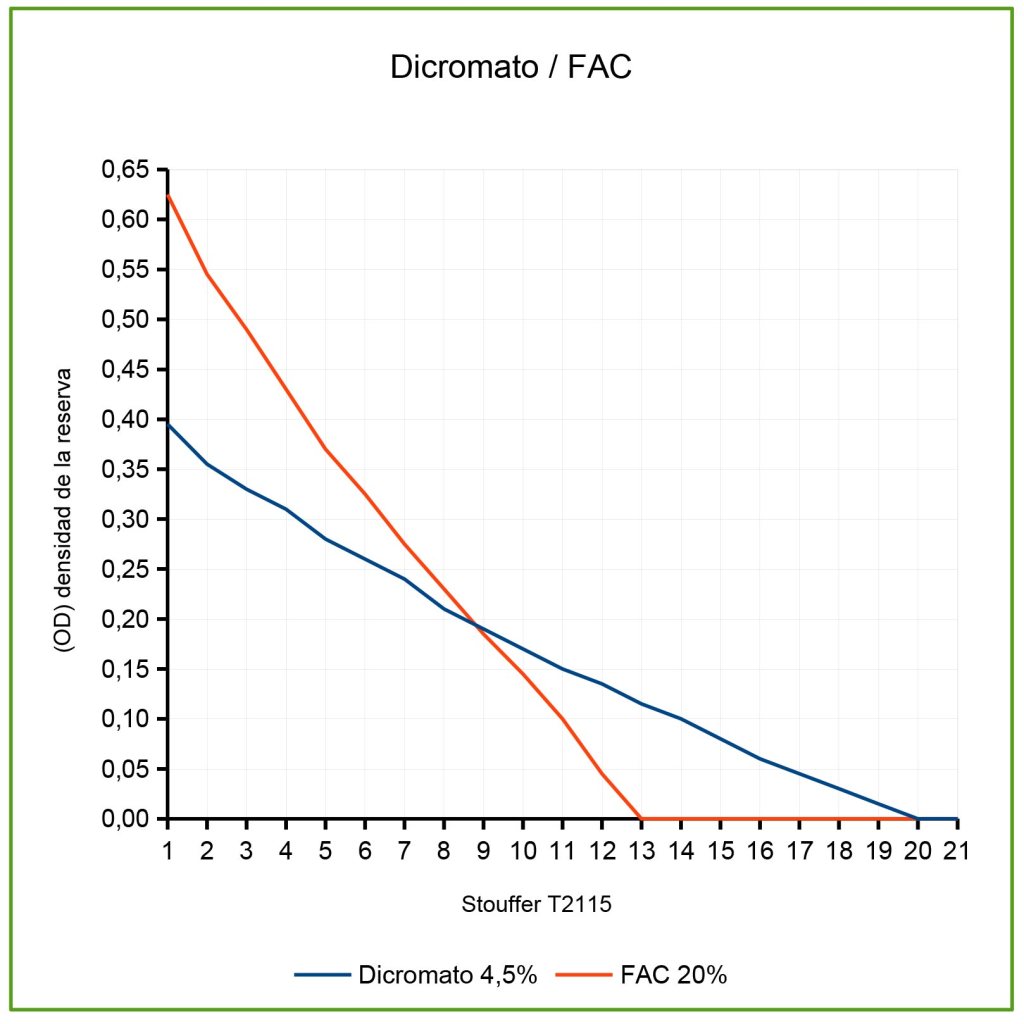
Al parecer, el FAC no experimenta la reacción en la oscuridad (dark reaction) descrita para el dicromato de potasio. Ello redunda en unas ciertas ventajas respecto del uso del dicromato de potasio, más allá de la permisividad legal en algunos países y de la alta toxicidad atribuible a todas las sales de Cromo. Preparando el soporte temporal sobre material sintético y añadiendo FAC a la papilla de gelatina pigmentada, se acorta sensiblemente el número de operaciones a realizar. Sacado del refrigerador, un soporte temporal así preparado se puede exponer directamente a la luz UV a través de la transparencia positiva (o trama + positivo) una vez estabilizado a la humedad y temperatura ambientes. Una vez expuesto, se puede polimerizar y adherir a la plancha de cobre. En la Fig. 1 se muestra un gráfico comparativo de las respectivas sensibilidades del dicromato de potasio y el FAC. Para ello se han sometido a un mismo tiempo de exposición dos soportes temporales sensibilizados respectivamente con una solución de dicromato de potasio al 4,5% y una de FAC al 20%. En él se puede observar lo siguiente:
- Calculada por este método, la sensibilidad del dicromato de potasio es algo más de 3 EV mayor que la del FAC.
- El FAC muestra una respuesta al aumento de exposición tan lineal como la del dicromato de potasio.
- La tasa de crecimiento del espesor de gelatina generado por el aumento de exposición (la pendiente del gráfico) es mayor que la mostrada por la del dicromato de potasio.
This post deals with the sensitivity and rate of thickness growth shown by hardened gelatin resists generated by the use of ferric ammonium citrate (FAC) as a substitute for potassium dichromate as a sensitizer for heliogravure.
First, it should be noted that the use of ferric salts entails a procedural change due to the different way in which the differential hardening of the gelatin resist that will protect the copper from mordant corrosion is achieved. When the sensitizer used is potassium bichromate or ammonium bichromate, exposure to ultraviolet (UV) light generates a hardening thickness of the pigmented gelatin in relation to the amount of light received by the temporary support. That is, the tone of the image on the positive transparency. Thus, light tones generate a greater thickness of hardened gelatin than dark tones.
In the case of ferric salts (FAC or FAO), UV light only transforms the ferric cation (Fe+3) into ferrous cation (Fe+2). That is, the areas that receive greater exposure, the clearest areas in the positive transparency, receive more UV light and consequently transform a greater quantity of ferric cations into ferrous cations, but the initial state of the gelatin does not change. Subsequently, the ferrous cations, mixed with hydrogen peroxide (H2O2), decompose the peroxide generating the formation of hydroxyl free radicals (HO·) which in turn are capable of initiating the polymerization process of gelatin and its hardening, which leads to an increase in the melting point. Therefore, prior exposure to UV light and subsequent mixing with hydrogen peroxide lead to a result similar to that obtained by exposure to UV light in the presence of potassium or ammonium bichromate. In summary, the process with FAC is as follows:
- Temporary support (carbon tissue) on synthetic with a layer composed of gelatin, plastifier and pigment.
- Sensitize by immersion in a FAC bath or by brush.
- Dry in darkness under dust free air flow.
- Expose to UV light through the positive transparency or through the screen and the transparency.
- Immerse in a hydrogen peroxide bath in order to proceed to the gelatin polimerization.
- Adhere to the copper plate.
- Washthe non-hardened gelatin with water at 45ºC – 50ºC.
- Then proceed to the etching in the usual way.
The use of these ferric salts allows for two forms of sensitization. The first, similar to the procedure for potassium dichromate, is by immersion in a FAC solution or by applying the sensitizer with a brush. Empirical tests show that to obtain consistent results, the FAC solution should be around 20%. Below 15%, unconsistency in sensitivity may be experienced. A second form of sensitization is to directly add the FAC to the pigmented gelatin glop. A 3% solution of salt shows consistent results after two months of keeping the temporary support in the dark and refrigerated. In this case, the procedure is as follows:
- Temporary synthetic paper support (carbon tissue) with a layer composed of gelatin, plasticizer, pigment and 3% of FAC.
- Remove from the refrigerator and allow to equilibrate to room temperature. To prevent condensation of water vapor on the surface of the gelatin, do not remove it from the airtight bag in which it is stored in the refrigerator until temperature equilibration has occurred.
- Expose to UV light (firstly through the screen if using double exposure) or directly through the positive transparency if using rosin or asphalt powder aquatint.
- Adhere to the copper plate.
- Wash with water at 45°C–50°C.
- Proceed with the etching as usual.
Apparently, FAC do not experiment the dark reaction described for potassium dichromate. This offers certain advantages over the use of the salt of chromium, beyond the legal requirements in some countries and the high toxicity attributable to all Chromium salts. By preparing the temporary support on synthetic material and adding FAC to the pigmented gelatin glop, the number of required operations is significantly reduced. Once removed from the refrigerator, a temporary support prepared in this way can be directly be exposed to UV light through the positive transparency (or screen + positive) after it has stabilized at ambient humidity and temperature. Once exposed, it can be polymerized and adhered to the copper plate. Fig. 1 shows a comparative graph of the respective sensitivities of potassium dichromate and FAC. For this purpose, two temporary supports sensitized respectively with a 4.5% potassium dichromate solution and a 20% FAC solution were exposed to the same exposure time. This can be observed:
- Calculated by this method, the sensitivity of potassium dichromate is slightly more than 3 EV greater than that of FAC.
- FAC shows a response to increasing exposure as linear as that of potassium bichromate.
- The rate of growth in gelatin thickness with increasing exposure (the slope of the graph) is greater than that shown by potassium dichromate.
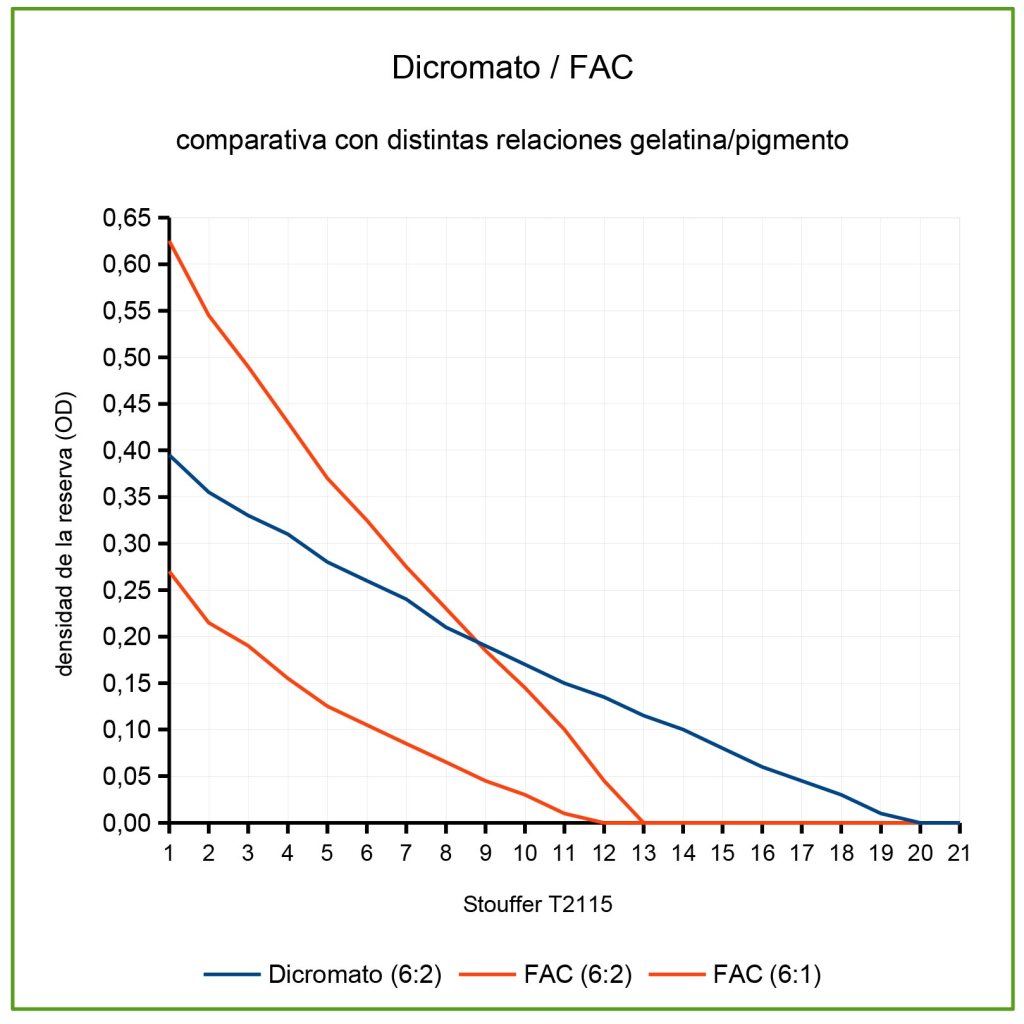
A la vista de estos resultados, es evidente que dicha tasa de crecimiento del espesor de gelatina provocará un cambio de comportamiento en la fase del grabado al ácido. Para tratar de mantener un comportamiento similar al habitual con dicromato de potasio, una vía es la reducción del contraste en la transparencia positiva. De todos modos y dada la gran diferencia de pendiente entre los gráficos respectivos del dicromato de potasio y los del FAC (Fig. 1), cabe plantearse antes otra opción, que consiste en la disminución del porcentaje de pigmento en el soporte temporal. Ello reduce la tasa de crecimiento del espesor de gelatina generado por la exposición, tal y como se muestra en la Fig. 2. Aunque se produce una ligera pérdida de sensibilidad de aproximadamente 0,5 EV, la pendiente es ahora más cercana a la obtenida con dicromato de potasio.
In view of these results, it is evident that this rate of gelatin thickness growth will cause a change in behavior during the acid etching phase. To maintain behavior similar to that typically seen with potassium bichromate, one approach is to reduce the contrast in the positive transparency. However, given the significant difference in slope between the graphs for potassium dichromate and those for FAC (Fig. 1), another option may be considered first. That is reducing the percentage of pigment in the temporary support. This reduces the growth rate of gelatin thickness generated by the exposure, as is shown in Fig. 2. Although there is a slight loss of sensitivity of around 0.5 EV, the slope is now closer to that obtained with potassium bichromate.
Si fuese necesario reducir aún más esta pendiente de crecimiento del espesor de gelatina, se podría aplicar previamente una curva de reducción del contraste a la imagen de la transparencia positiva. Curva que gracias a la reducción aplicada anteriormente mediante el uso de un soporte temporal con menos pigmento, no será tan agresiva con la imagen y no comprometerá las prestaciones de la impresora para reproducir la escala tonal del archivo de imagen original. Esta curva, debería preservar tanto el blanco (0% de tinta) como el negro (100% de tinta). Para ello se puede generar una curva, en el programa de procesado de imagen que se utilice, como la que se muestra en la Fig. 3, diseñada en Adobe Photoshop.
To achieve a gradient reduction similar to that of potassium dichromate, a contrast reduction curve can now be applied to the positive transparency image. Thanks to the reduction previously applied by using a temporary support with less pigment, this curve will not be as aggressive on the image and will not compromise the printer’s ability to reproduce the tonal scale of the original image file. This curve should preserve both white (0% ink) and black (100% ink) as much as possible. To do this, we can generate a curve in our image processing program, like the one shown in Fig. 3, designed in Adobe Photoshop.
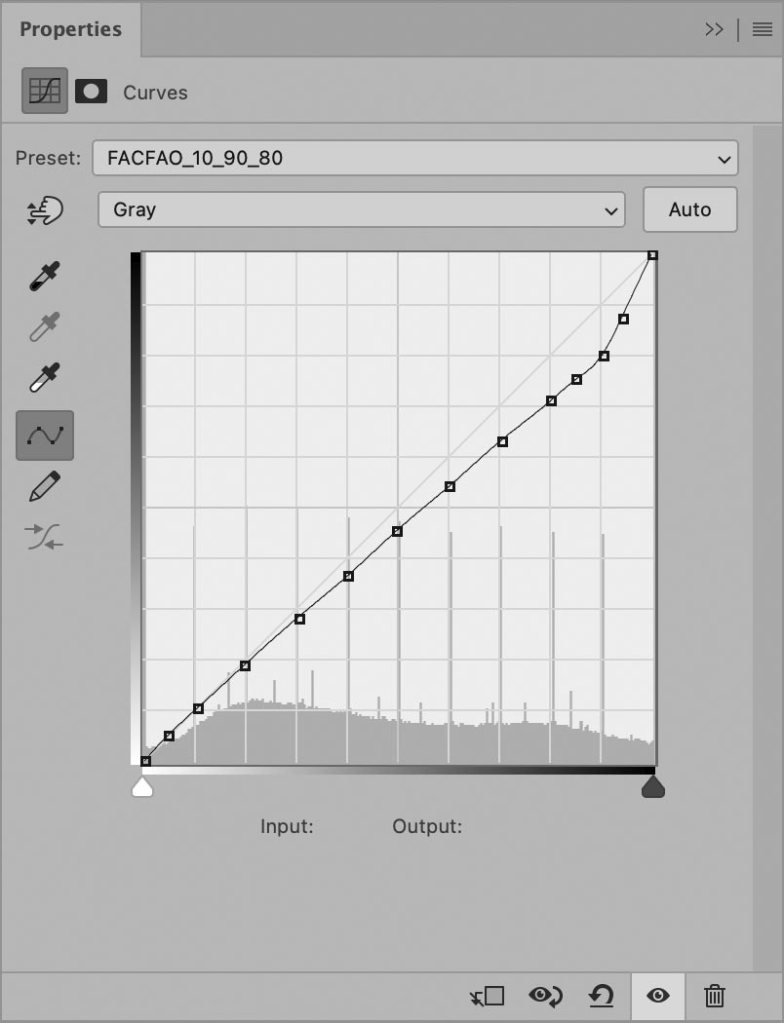
Es importante resaltar que la “curva” aplicada es en realidad una recta en la que sólo cambia la pendiente inicial. Recordemos que la respuesta del FAC al incremento de exposición es lineal y que, como ya se comentó, en posts anteriores, el proceso de grabado al ácido del cobre mediante el uso de cloruro de hierro es también esencialmente lineal. No procede, por lo tanto, modificar esta linealidad en el trazado de la curva de reducción del contraste. Aplicar la modificación a partir del 10% de tinta ayuda a preservar una buena separación entre el blanco puro y el “casi balnco”. En el blanco puro se genera un grosor de gelatina suficientemente distinto del del 10%, lo que permite un cierto margen de seguridad al dar por finalizada la mordida sin riesgo de ensuciar los blancos. Lo mismo sucede en la zona de las sombras, dejando el negro en 100% y aplicando el comando Boost de QTR tal y como se explica en El comando “Boost” de QTR en Heliograbado, se facilita la obtención de un negro profundo tan denso como la tinta en uso sea capaz de proporcionar. Al mismo tiempo, se consigue separar bien el negro del 100% de las sombras profundas (90%).
En la el siguiente post sobre este tema, Citrato Férrico Amónico (FAC) como sensibilizante para Heliograbado (III), se mostrarán resultados y se comentarán algunos detalles del método propuesto.
It is important to note that the applied “curve” is actually a straight line whose slope is the only change with respect the initial. Recall that the FAC response to increasing exposure is linear, and that, as discussed in previous posts, the etching of copper using iron chloride is also essentially linear. Therefore, it is not appropriate to modify this linearity in the plot of the contrast modification curve. Applying the modification starting at 10% ink helps maintain good separation between pure white and “near-white.” In pure white, a gelatin thickness sufficiently different from that at 10% is generated, allowing a certain safety margin upon completion of etching without the risk of polluting the whites. The same thing happens in the shadows. Leaving the black at 100% and applying the QTR Boost command as explained in The QTR “Boost” command in Heliogravure makes it easier to obtain a deep black as dense as the ink in use can provide. At the same time, it helps separate the 100% black from the deep shadows (90%).
In the next post on this topic, Ferric Ammonic Citrate (FAC) as Heliogravure sensitizer (III), results will be shown and some details of the proposed method will be discussed.
 Carles Mitjà - ASIS/FRPS
One Reply to “”