

Después de doce años con la Fujifilm X100 como cámara de diario y un buen número de satisfacciones, pensé en renovarla. La primera opción era la nueva versión de la misma cámara, la X100VI, que con un sensor del mismo formato de ≈ 15×23 mm, mantiene el soberbio objetivo Fujinon Super EBC de 23 mm f/2. Luminoso, compacto y con un rendimiento excelente. Con el formato de sensor mencionado, el campo de visión equivalente en formato 24×36 mm es el de una longitud focal de 35 mm. El nuevo modelo, la X100VI incorpora un sensor del mismo tamaño pero con 40 MP frente a los modestos 12 MP de la X100, otro procesador, mejor visor electrónico, mejor sistema AF, estabilizador de imagen (IBIS) y todas las mejoras que se han ido introduciendo en estos 12 años. Pero hace poco más de un año, Fujifilm presentó la GFX100RF, anunciada como la primera “compacta” de formato medio. Una especie de “hermana mayor” de la serie X100 y ésta ha sido mi elección. El sensor tiene un tamaño de ≈ 33×44 mm y 102 MP, lo que supone un pixel pitch de ≈ 4 µm. Sólo estas cifras ya suponen un cambio de paradigma. Un sensor con una área 1,7 veces mayor que la de los denominados full frame (24×36 mm). La cámara, siguiendo la tradición de la serie X100, incorpora un objetivo fijo Fujinon Super EBC GF de 35 mm f/4. Con el formato de sensor mencionado, el ángulo de visión equivalente en formato 24×36 mm es de 28 mm. Si se quiere establecer una comparación en relación a la calidad de imagen, el pixel pitch de la “hermana pequeña”, la X100VI, es de 3,4 µm. Huelga decir que la nueva GFX100RF ofrece todas la mejoras equivalentes al desarrollo de estos 12 años con sólo un par de diferencias respecto a la X100VI. No dispone de estabilizador y la luminosidad de f/4 frente al f/2 de la serie X100 puede ser un handicap en determinados casos. En unas mimas condiciones, el objetivo de la GFX100RF capta cuatro veces menos luz hacia el sensor que en la X100. Por otra parte, el cambio de apertura máxima implica también cambios en la profundidad de campo a dicha apertura. En la Fig. 1 se comparan las dos cámaras con sus respectivos objetivos de longitud focal fija.
After twelve years of using the Fujifilm X100 as my everyday camera, and having enjoyed it immensely, I decided to upgrade it. My first choice was the new version of the same camera, the X100VI, which, with a sensor of the same ≈ 15×23 mm format, retains the superb 23 mm f/2 Fujinon Super EBC lens. It is bright, compact and delivers excellent performance. With this sensor format, the equivalent field of view in 24×36 mm format is of a 35 mm focal length. The new model, the X100VI, features a sensor of the same size but with 40 MP compared to the X100’s modest 12 MP, a different processor, an improved electronic viewfinder, an improved AF system, in-body image stabilisation (IBIS) and all the enhancements that have been introduced over the past 12 years. But just over a year ago, Fujifilm unveiled the GFX100RF, billed as the first medium-format ‘compact’. A sort of ‘big sister’ to the X100 series and this is what I’ve chosen. The sensor measures ≈ 33×44 mm and has 102 MP, resulting in a pixel pitch of ≈ 4 µm. These figures alone represent a paradigm shift. A sensor with an area 1.7 times larger than that of so-called full-frame sensors (24×36 mm). In keeping with the tradition of the X100 series, the camera features a fixed 35 mm f/4 Fujinon Super EBC GF lens. With the aforementioned sensor format, the equivalent focal length in 24×36 mm format is 28 mm. To draw a comparison in terms of image quality, the pixel pitch of its ‘little sister’, the X100VI, is 3.4 µm. It goes without saying that the new GFX100RF offers all the improvements resulting from 12 years of development, with just a couple of differences compared to the X100VI. It lacks image stabilisation, and the f/4 aperture, compared to the f/2 of the X100 series, may be a handicap in certain situations. Under the same conditions, the GFX100RF’s lens gathers four times less light onto the sensor than the X100. Furthermore, the change in maximum aperture also results in changes of depth of field at that aperture. Figure 1 compares the two cameras with their respective fixed focal length lenses.
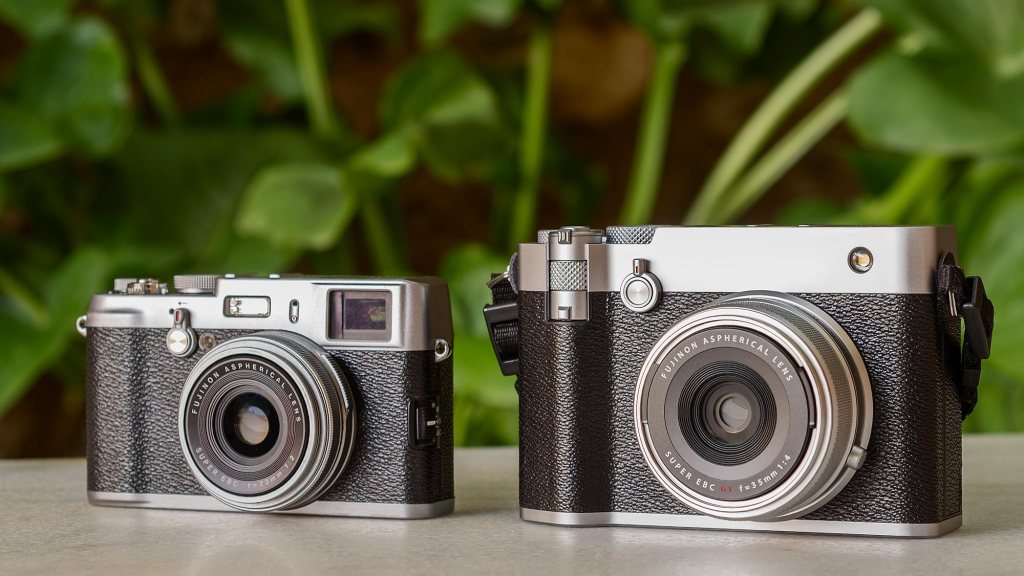
Figure 1 – At left, the Fujifilm X100. At right, the Fujifilm GFX100RF.
En la Fig. 1 se aprecia el aumento de altura de la nueva GFX100RF y también un mayor diámetro del barrilete del objetivo que, en su parte trasera debe cubrir una superficie de sensor mucho mayor. Una diferencia es que la nueva cámara sólo incorpora el visor electrónico (EVF), mientras que la X100, que también dispone de EVF, muestra a la derecha del objetivo su visor óptico. En la X100 se aprecia también el pequeño flash incorporado, mientras que la GFX100RF no lo tiene. Por lo demás, el aspecto en general es muy similar. En la Fig. 2 se muestran ambas cámaras en orden de uso, con sus respectivos parasoles y a la X100 se le ha incorporado el accesorio óptico Fujinon WCL-X100 para que la longitud focal del objetivo pase de 23 mm a ≈ 18 mm, lo que equivale a una longitud focal de 28 mm en formato completo 24×36 mm. De esta forma, ambas cámaras son ahora comparativas en cuanto a ángulo de visión.
Fig. 1 shows that the new GFX100RF is taller and also has a larger lens barrel diameter; the rear part of the lens must cover a much larger sensor area. One difference is that the new camera only features an electronic viewfinder (EVF), whilst the X100, which also has an EVF, shows its optical viewfinder to the right of the lens. The X100 also features a small built-in flash, whereas the GFX100RF does not. Otherwise, the overall appearance is very similar. Fig. 2 shows both cameras in the order in which they are used, with their respective lens hoods and the X100 has been fitted with the Fujinon WCL-X100 optical accessory so that the lens’s focal length changes from 23 mm to ≈ 18 mm, which is equivalent to a focal length of 28 mm in the 24×36 mm full-frame format. In this way, both cameras are now comparable in terms of angle of view.
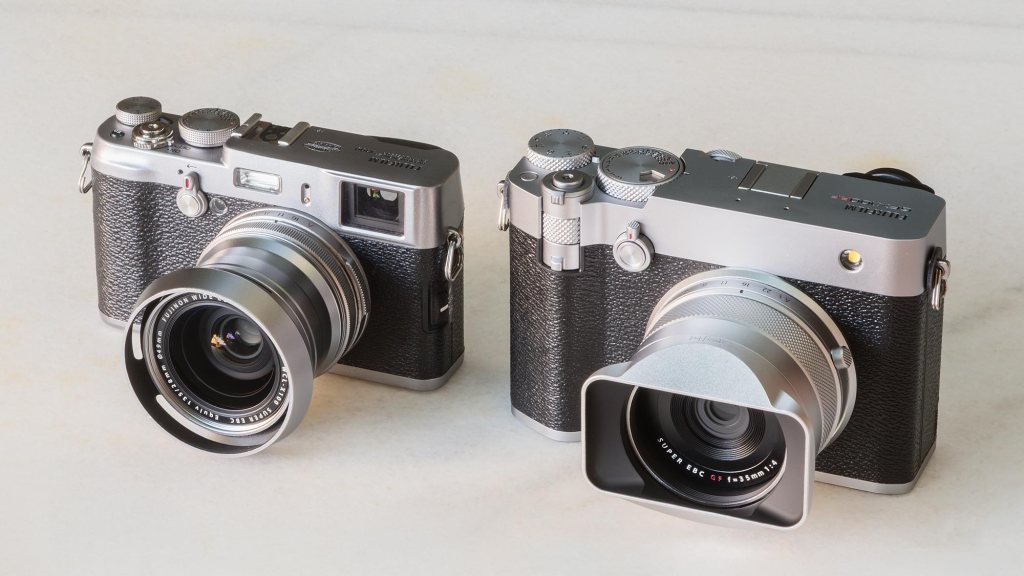
Figure 2 – At left, the Fujifilm X100 with the optical suplement WCL-X100 and its lens hood. At right, the Fujifilm GFX100RF with the SquareHood lens hood.
Equipando la X100 con el suplemento óptico WCL-X100 y el parasol, el tamaño comparativo ya no es tan diferente. El peso se sitúa en los 585 g, frente a los 809 g de la GFX100RF. Aún así, si se añade al equipo el suplemento óptico TCL-X100 que permite alargar la longitud focal del objetivo original a 32 mm (≈ 48 mm en formato 24×36 mm), el peso del conjunto de la X100 sube a 765 g. Con sólo 44 g más, la GFX100RF no necesita accesorios ópticos y permite, con el recorte equivalente a una longitud focal de 80 mm (≈ 63 mm en formato 24×36 mm) conservar un archivo de imagen de 20 MP. No obstante, en este tipo de comparaciones y al margen del tamaño de archivo de imagen finalmente disponible, debe tenerse también en cuenta que un recorte de superficie de sensor no es lo mismo que un aumento real de la longitud focal del objetivo, ni en términos de calidad ni sobre todo, de profundidad de campo, aspectos que se discutirán quizá más adelante en otros posts.
When the X100 is fitted with the WCL-X100 optical attachment and the lens hood, the size difference is no longer so significant. It weighs 585 g, compared with the GFX100RF’s 809 g. However, if you add the TCL-X100 optical attachment to the kit – which extends the focal length of the original lens to 32 mm (≈ 48 mm in 24×36 mm format) – the total weight of the X100 setup rises to 765 g. Weighing just 44 g more, the GFX100RF requires no optical accessories and, with a crop equivalent to a focal length of 80 mm (≈ 63 mm in 24×36 mm format), retains a 20 MP image file. However, in comparisons of this kind – and setting aside the final image file size – it should also be borne in mind that cropping the sensor area is not the same as a real increase in the lens’s focal length, either in terms of quality or, above all, depth of field – aspects that may be discussed in more detail in future posts.


Felicitacinones!!!
LikeLike